
A king cannot represent his people if he is out of touch with their lived experience. Charles III wore a 6kg golden robe in not one but two carriages, the diamond jubilee coach on the way to the ceremony at Westminster Abbey in which he was crowned monarch and the gold state coach, which has been used in every coronation since 1831, on the way back to Buckingham Palace.
These cultural relics cannot help to reconcile the differences between the royal aristocracy and their suffering subjects, as the vast expense lavished on the king’s event was branded a ‘slap in the face‘ to ordinary people struggling through the cost-of-living crisis. Young people are especially indifferent to royal affairs.
An online poll I carried out showed that most young people aged between 18-24 were uninterested in following the coronation as 82% did not see themselves tuning into the crowning ceremony. 88% thought that the £100 million earmarked for the coronation should have been spent elsewhere.
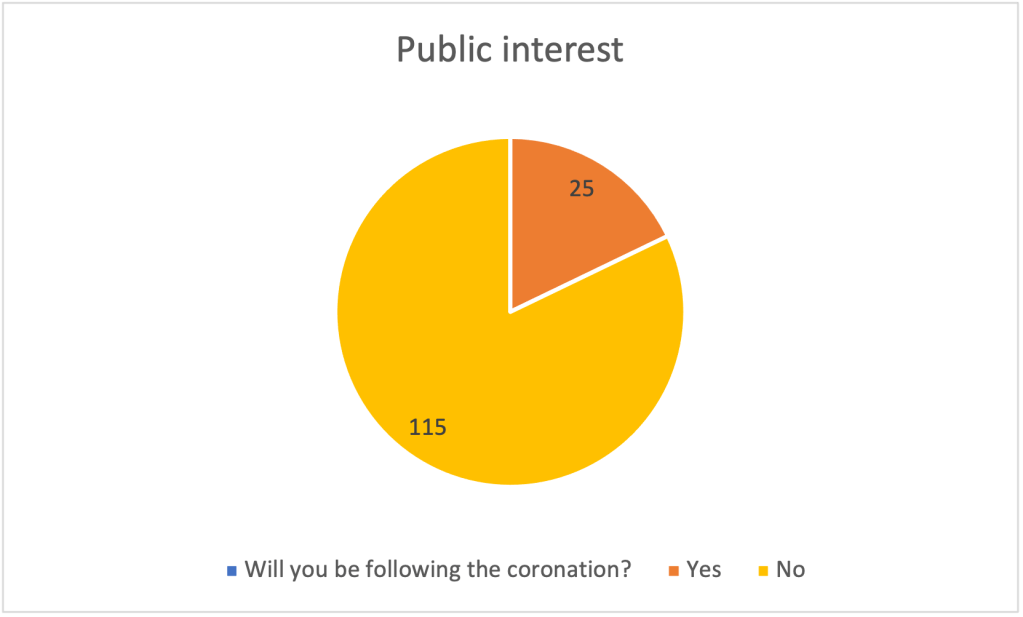
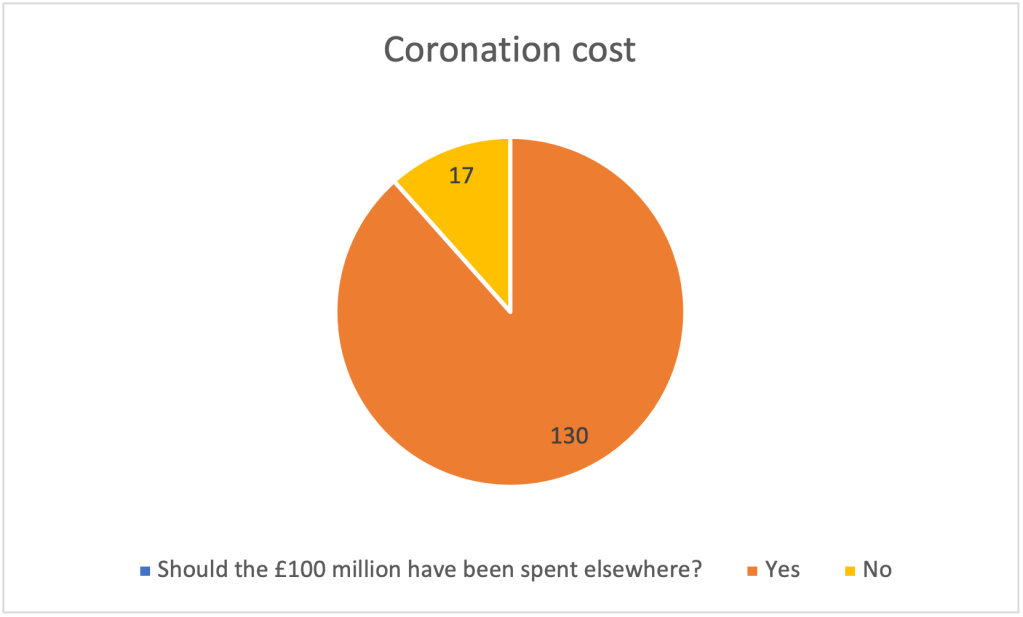
It is possible that there would have been a greater majority insofar as £100 million was a conservative estimate for the cost of the coronation with the real figure potentially as high as £250 million due to a massive security bill.
However, 23% said they were supporters of the monarchy, suggesting that even those who did support them felt the spending on the coronation was unwarranted. This seems to be borne out by the fact that 31% thought that the royal family serve an important function in our society.
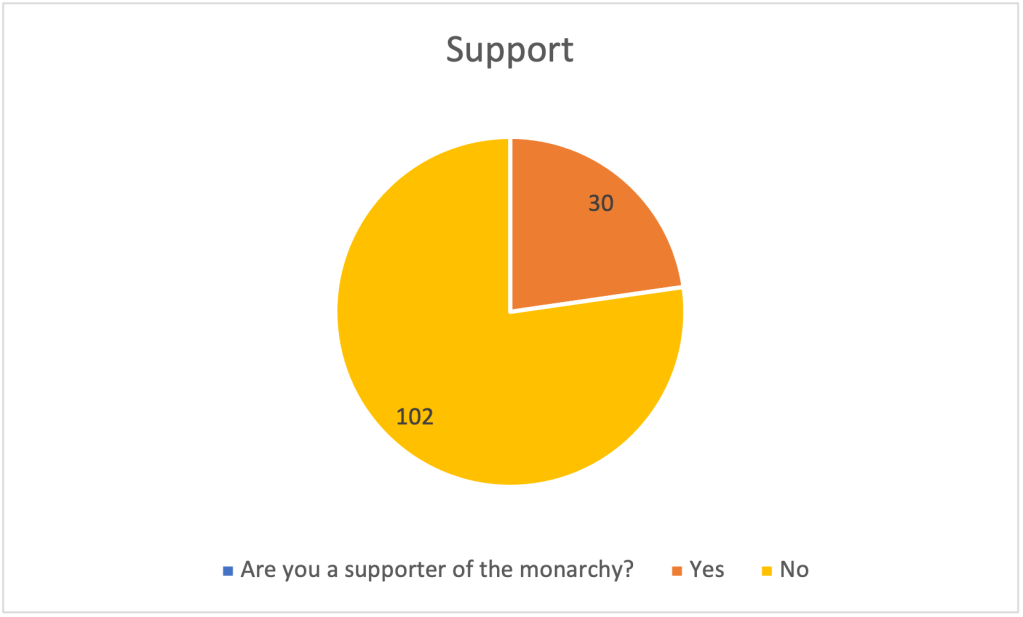

More young people thought that the monarchy served an important function than supported it, suggesting that it was unclear to them that what they do merits support even if they believe they play a meaningful role.
While some young people felt that the royal family play a valuable role, fewer supported the monarchy as a political institution and barely any felt the outlay for the king’s coronation was justified under the circumstances, as many households are in dire straits and struggling to make ends meet.
A vast majority of over 90% believed that the pomp was inappropriate during the cost-of-living crisis. Perhaps because it showed in striking terms how wide the gap between the average family and one of the richest really is.

Young people may identify less with the royal family because they feel even more out of touch with them than they have in the past. At a time when most people are straining to earn enough to pay their rent, cover their bills and buy their food, an amount of money that could change many of their lives was spent on a pompous celebration.
Alex Thorpe, a 24 year old poller I followed up, said: “I don’t see why people are interested in the monarchy in general or what qualities you’re supposed to admire about them.”
Of the purported £100 million spent on the ceremony he added that “People who weren’t born into state wealth and power because of their bloodline have actual problems that could be addressed with that same government money.” As a result, he believes that the institution is outdated from a practical standpoint.
Bad timing
To many young people the coronation was not as worthy of public spending as assisting those whose basic financial needs are not being met during the present crisis. Many believed that the pageantry is inappropriate given what people are going through in these trying times.
Some who like the monarchy tempered their support when thinking on the seeming injustice of spending so much when people have so little. The large sum used to put on a show for the crowning of one man when millions of people are struggling seemed excessive even to those who are sympathetic to the monarchy.
Between the age groups there was a majority who thought that the massive amount spent on the coronation should not have been funded by the government. This is after all a king with a private estate of around £1.8 billion, but taxpayers footed the bill for his crowning ceremony.

The viewing figures for the king’s coronation, while still high at 20 million, were much lower than the 29 million that watched the queen’s funeral last September. The fall of 9 million is staggering because it suggests that the generational divide is slightly overstated as older generations are losing interest too.
Public support for the monarchy is now at its record lowest. 18-24 year olds seem to be the main drivers of the shift in opinion as 40% would prefer an elected head of state and only 36% want to keep the monarchy. This is half as many as in 2013, only a decade ago, when 72% supported the institution.
Britain is changing and people, particularly the young, are questioning whether the monarchy is an outdated institution. Republicanism, the belief that the monarchy should be abolished and replaced with an elected head of state, has never been more popular.
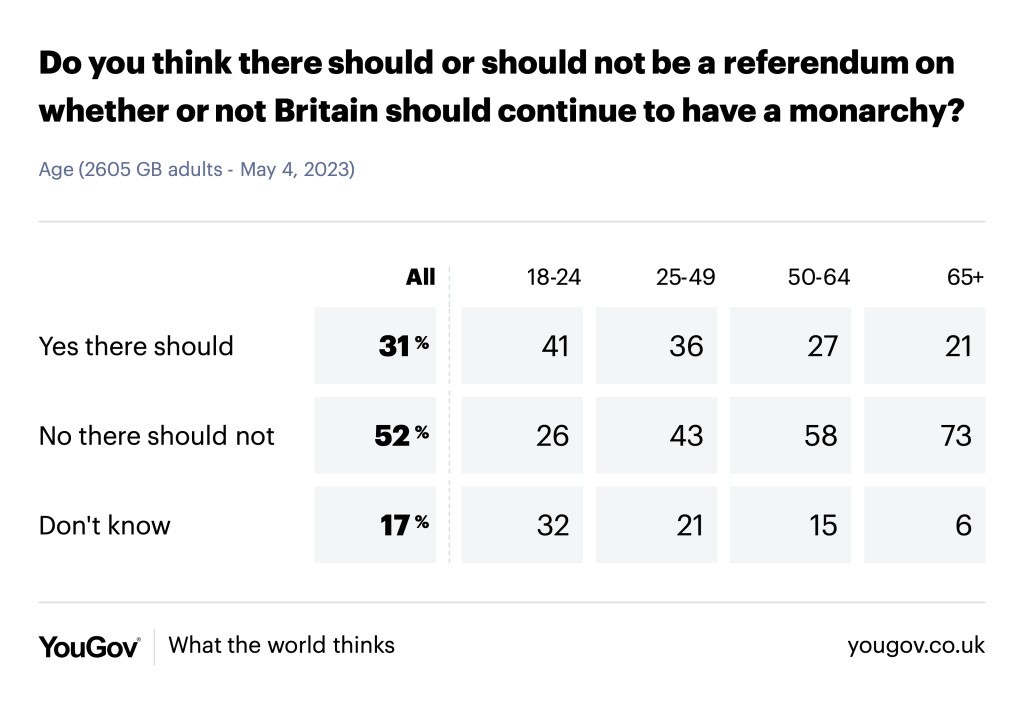
Nevertheless, while young people are turning the tide the old guard is holding firm and radical reform to the constitution remains a pipe dream for republicans. Another YouGov poll carried out in April 2023 showed that 62% supported the monarchy while 25% wanted a republic.
Change to the constitution is a long way off because the majority of Britain prefer the monarchy, but that perspective will become less common if 18-24 year olds continue to hold their views as they age and this trend carries over into the older age groups.
If this happens it is not inconceivable that support for a republic will grow considerably within a few decades. Eventually, with fewer supporters than detractors, the monarchy’s role in the constitution will have to be looked at more closely and put to a democratic vote.
That is what Republic, an anti-monarchy organisation, is hoping for. In an interview with Time magazine their CEO, Graham Smith, said: “It’s really people over the age of 65 who keep the overall poll above 50%, and I think that’s going to change over the next 10 years … If the support does go under 50% then the monarchy loses any last claim to legitimacy, and then there has to be a serious debate about getting rid of it.”
Less support for the monarchy and more clamouring for a republic in which there are no ‘rulers’ and ‘subjects’ would make a referendum more likely. In the 21st century, republicans argue that could not come sooner and while monarchists remain staunch opponents, there has been a seismic shift in opinions over the last decade.
If the monarchy’s decline in popularity continues then the republican movement, reinforced by young people, will be increasingly hard to ignore. If they get their way King Charles III could be the last British monarch.



 🄰🄳🄸
🄰🄳🄸 